 how-to
Minimizing Disruption During Home Renovations: 7 Steps
Table of Contents
- Step 1: Plan the Renovation Before Work Begins
- Step 2: Choose and Coordinate Reliable Contractors
- Step 3: Protect Floors, Furniture and Belongings
- Step 4: How to Reduce Dust During Renovation
- Step 5: Living in Your Home During Renovation
- Step 6: Home Renovation Timeline and Schedule
- Step 7: Renovation Checklist for Homeowners
- Frequently Asked Questions
Last Updated: October 19, 2026
Step 1: Plan the Renovation Before Work Begins
Minimizing disruption during home renovations starts with the plan, not the tools. At Bristol Construction & Heating Co Ltd, most chaos comes from decisions made too late.
Set Realistic Expectations and Timelines
A home renovation always throws up something: a hidden pipe, a slow council response, a materials delay. Agree these before anyone lifts a tool:
- A written timeline with start and finish dates
- Which stages depend on each other
- A clear rule for how schedule changes get communicated
According to guidance from the UK Government on building regulations approval, some works need approval before they start, so build that waiting time into your plan rather than discovering it mid-build.
Agree Working Hours and Schedules
A construction schedule is only useful if the household knows it. Fix these in writing:
- Daily start and finish times
- Days off and expected quiet periods
- Notice given before any change to the schedule
Step 2: Choose and Coordinate Reliable Contractors
A reliable team is the biggest factor in a low-stress renovation. When one contractor manages the whole job, there's no gap between trades and no finger-pointing. Hire a loft specialist, heating engineer and electrician separately and you spend the project chasing each, while tasks slip because nobody owns the delay.
One Accountable Team vs Multiple Trades
At Bristol Construction & Heating Co Ltd, we run building and heating work under one roof, with no sub-contracting. That means one team answers for the timeline, the price and the finish.
| Approach | Who owns delays | Communication | Best for |
|---|---|---|---|
| One accountable team | The lead contractor | Single point of contact | Whole-house projects |
| Multiple separate trades | You, the homeowner | You coordinate everyone | Small single jobs |
A single team also means the construction schedule and the heating install are planned together, not bolted on at the end.
Step 3: Protect Floors, Furniture and Belongings
Surface protection is cheap compared with repairing a scratched floor or stained sofa. Move what you can and cover what stays:
- Floor coverings: heavy-duty sheets on walkways and hard floors
- Furniture protection: dust sheets over anything that can't be moved
- Fragile items: boxed and stored away from the worksite
A tidy site protects your home and speeds up the team. Clear access also cuts trips and damage.
Step 4: How to Reduce Dust During Renovation
Dust control is where most renovations lose the goodwill of the household. Fine dust travels further than expected and stays airborne for hours, so you need three layers: stop dust at source, keep it in the work zone, and clean the air that escapes.
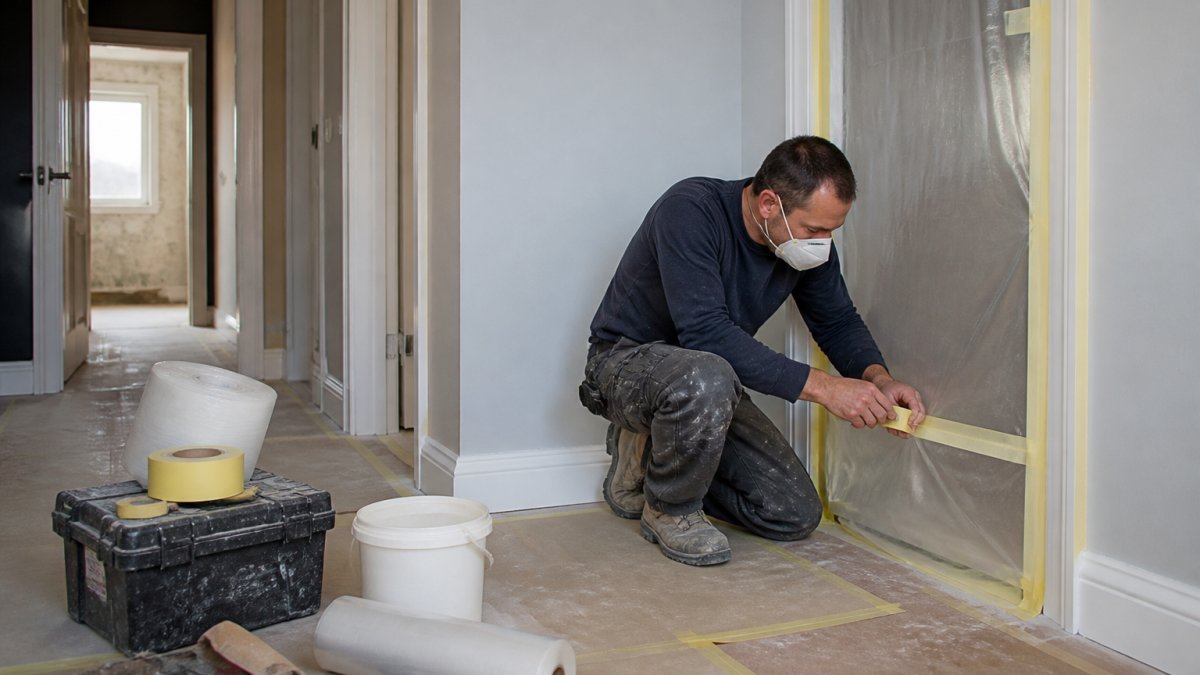
Dust Barriers and Sealed Doorways
Plastic barriers and sealed doorways keep dust in the work zone. Tape sheeting across doorways, seal the edges, use zipped access panels, cover vents and gaps, keep a mat at the barrier exit, and damp-wipe rather than dry-sweep. A few refinements make a big difference:
- Use a two-door barrier where possible. A small lobby of two sheets with a gap between them stops the pressure wave that carries dust when a door is opened.
- Seal the top and bottom of every sheet. Dust moves on air currents, and an unsealed edge is an open door.
- Tape down floor protection at the barrier line. Loose sheets curl and let debris track out.
Indoor Air Quality Controls
Indoor air quality matters, especially with children or anyone with breathing issues. Run an extractor fan or air scrubber in the work zone and open windows briefly to clear the air.
The NHS advice on air pollution and lung health is a useful reminder that fine dust is worth taking seriously. Ask your contractor how they plan to control it.
For a more robust approach, think in terms of pressure and filtration:
- Negative pressure. A fan extracting air from the work zone to outside keeps the zone at lower pressure than the rest of the house, so air flows in rather than dust flowing out. This is the single most effective control for fine dust.
- Filtration. Where extraction to outside is not possible, a HEPA-filtered air scrubber sized for the room volume will capture fine particles. Change or clean filters as the manufacturer specifies.
- Ventilation timing. Open windows on the clean side briefly after dusty tasks, not during them, to avoid pulling dust through the house.
Hazardous Materials and When to Call a Specialist
Some dust is more than a nuisance. Older properties can contain asbestos in insulation, ceiling tiles, floor tiles and textured coatings, and disturbing it is a serious health risk. Lead paint and silica dust are also hazards.
- Do not disturb suspected asbestos. Stop work and arrange a survey by a competent person before anything is cut, drilled or removed.
- Treat silica dust as a respiratory hazard. Concrete cutting and chasing should use water suppression or on-tool extraction, and the team should wear suitable respiratory protection.
- Ask for a written method statement for dust and hazardous materials before work starts. A reputable contractor will have one.
Cleaning Up After Dust
Containment only works if the clean-up matches it. Dry sweeping and standard vacuuming simply redistribute fine dust.
- Use a vacuum with a HEPA filter, not a domestic model without one.
- Damp-wipe surfaces from top to bottom and rinse the cloth often.
- Clean the barrier line and the route to the exit last.
A short conversation about pressure, filtration and hazardous materials before work begins will tell you quickly whether your contractor takes dust seriously.
Step 5: Living in Your Home During Renovation
Living in your home during renovation is possible with planning. Keep a usable routine in the rooms that stay clear, and decide room by room what 'usable' means.
A Room-by-Room Continuity Plan
A general checklist isn't enough when four people, a dog and a home office all need somewhere to be. Build a continuity plan before work starts: for each room, decide whether it's in the work zone, a protected route, or a temporary substitute.
- Kitchen. If it is out of action, identify the substitute room and what it can support (power, water, ventilation).
- Bathroom. If the only bathroom is being refurbished, agree a temporary arrangement, a second bathroom, a family member's house, or a hired unit, before work begins.
- Bedrooms. Keep at least one bedroom fully clear of dust and accessible without crossing the work zone.
Write the plan down and share it with the contractor. It becomes the reference point when the schedule changes.
Temporary Kitchen and Cooking Arrangements
If the kitchen is out of action, set up a temporary kitchen elsewhere. A microwave, mini-fridge and hot plate in a spare room covers most meals. Choose a room away from the dust zone, keep a kettle and basic utensils together, plan simple meals, and store food sealed. A few additions make it workable for more than a few days:
- Check the electrics. A hot plate and kettle on an extension lead is a risk. Use a circuit that can carry the load and keep cables away from walkways.
- Plan washing-up. A washing-up bowl, a supply of paper towels and a route to a sink or utility tap will save arguments.
- Keep a 'first night' box. Kettle, mugs, tea, coffee, cutlery and a tin opener in one place means the first evening does not depend on finding anything.
Noise, Working Hours and Neighbours
Noise is the disruption neighbours notice most, and you can manage it proactively.
- Front-load the loudest work. Breaking out walls, lifting floors and chasing walls are best done early, when goodwill is highest.
- Agree noisy hours in writing. Most local authorities accept construction noise within reasonable daytime hours on weekdays and Saturdays; early mornings, evenings and Sundays are the flashpoints.
- Tell neighbours before work starts. A short note with the start date, expected duration and a contact number prevents most complaints.
Children, Pets and Accessibility Needs
Children, pets and anyone with mobility or health needs require extra thought. Keep a safe route through the house and agree where tools and materials are stored.
- Children. Agree a hard boundary, a stair gate, a closed door or a marked line, and make sure the team knows it. Keep school bags, uniforms and homework away from the dust zone.
- Pets. Cats and dogs are unsettled by noise and strangers. Identify a quiet room, keep doors closed, and plan for the days when the front door will be open for long periods.
- Mobility and health needs. If someone uses a wheelchair, walking aid or oxygen equipment, the protected route must stay wide, lit and free of cables and debris. Tell the contractor about any equipment that needs power or clear space.
Decide which rooms stay usable, which are off-limits, and how each person moves through the house, then review it at the start of each phase.
Step 6: Home Renovation Timeline and Schedule
A home renovation timeline and schedule keep everyone aligned. The sequence of tasks matters as much as the dates.
Task Sequencing and Contingency Planning
Task sequencing means doing jobs in the right order: strip out, structural work, first fix, then finishes. Get it wrong and trades wait on each other. Build in contingency for delays, materials can arrive late and approvals can take longer than expected, and budget for temporary arrangements such as takeaways, a launderette or a short stay elsewhere.
Step 7: Renovation Checklist for Homeowners
A renovation checklist for homeowners keeps the practical side in one place. Use this before and during work:
- Written timeline and fixed price agreed
- Working hours and quiet periods confirmed
- One named contact for the project
At Bristol Construction & Heating Co Ltd, we give every project a fixed written price and timeline before work begins. That, plus a workmanship guarantee and Gas Safe registered engineers (reg. 970515), is how we keep disruption to a minimum.
Frequently Asked Questions
Is it normal to feel overwhelmed during a house renovation?
Yes, it is common. Even a well-run project brings noise, dust and changes to your daily routine. The feeling usually comes from uncertainty rather than the work itself, so ask for a written schedule and a named contact before work starts. Knowing which rooms are affected each week and when the noisy phases end makes the disruption feel manageable. If you are living in your home during renovation, plan a quiet room and a temporary cooking setup in advance.
How can you reduce dust and mess during a home renovation?
Use plastic dust barriers and sealed doorways to separate the worksite from living areas, and ask for floor coverings and furniture protection before demolition begins. Keep windows in the work zone closed while cutting, and ventilate rooms afterwards. A tidy site with daily debris removal stops mess spreading through the house. If you are wondering how to reduce dust during renovation, the biggest gains come from containment at the doorway, not from cleaning afterwards.
Can you live in your home during renovation work?
Often yes, especially for loft conversions and single-room projects. Living in your home during renovation works best when you agree working hours in advance, keep one room dust-free, and set up a temporary kitchen with a microwave, mini-fridge and hot plate if the main one is out of action. For whole-house projects or major heating replacements, moving out for part of the schedule may be calmer. Discuss the realistic options with your contractor before signing.
How can you keep a renovation on schedule?
Agree a detailed home renovation timeline and schedule before work begins, including task sequencing and decision deadlines for you as the homeowner. Late choices on tiles, kitchens or heating systems are a common cause of delay. Build in contingency for planning permission and unexpected findings such as asbestos. A renovation checklist for homeowners helps you track what you need to sign off and when, so the construction schedule keeps moving.
Minimizing disruption during home renovations comes down to planning, one accountable team and honest communication. If you're weighing up a loft conversion, extension or heating upgrade and want a clear plan before you commit, we can help. Bristol Construction & Heating Co Ltd manages the whole project from design to sign-off, with building and heating under one roof and no sub-contracting. Start a project with us and get a fixed written price and timeline before any work begins.